
Blog
When Your Product Evolves After Filing a Patent Application – How to Avoid the Pitfalls
7 July 2026
Reading time: 6 minutes
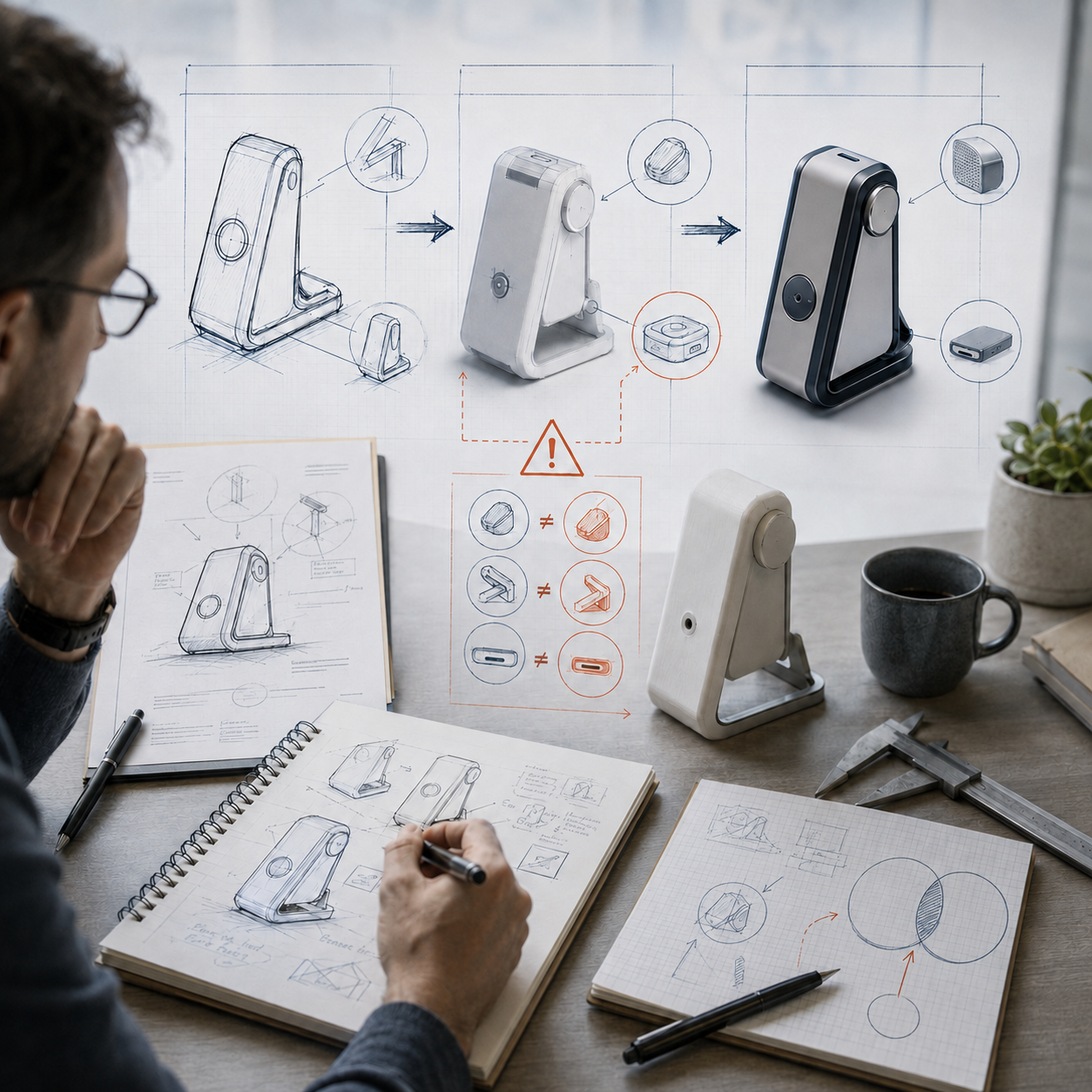
Many young technology companies choose to file patent applications at an early stage, sometimes even before they have reached the prototype phase. An early filing date can be crucial if you intend to disclose your invention to investors, customers, suppliers or collaboration partners.
However, if a patent application is filed before the concept has reached a more advanced stage of development, there is a risk that the commercialized product may no longer be covered by the patent protection. Along the way, designs may change, components may be replaced and material choices may be revised. Details that worked perfectly well in prototypes may, for example, prove unsuitable for series production. This is something that needs to be taken into account by a patent adviser – and it is something we at Groth & Co keep firmly in mind.
Why file a patent application before the product is close to series production?
Timing is generally very important. Often, a company wants to show or test a new product as soon as possible with potential customers and collaboration partners in order to assess the market potential. To do this safely, it may be possible to file one or more preliminary patent applications to provide provisional protection for the invention. In some cases, it can be entirely appropriate to seek patent protection early, provided that the protection is as broad and well considered as possible, with multiple variants and fallback positions. In other cases, it can be more challenging, for example where the concept is complex and the prototype can be built in several alternative ways, all based on the same inventive idea. It is also important to consider the risk that a prototype may end up having disproportionately great significance in the patent text.
Why can’t a patent application always be corrected afterwards?
A common misconception is that it is always possible to “add” new versions later. In patent law there are strict rules on what may be added to a patent application after filing. It is not possible to supplement a patent application retrospectively with new technical features while retaining the original filing date for those particular features. Sometimes, the original application contains sufficient support to allow an amendment to be made. It may also be possible to file additional material or a further developed application within 12 months of the first filing date, although the added part may then receive a later relevant date. This is therefore important to consider from the outset in the dialogue between the inventor or customer and the adviser. Good communication is therefore essential.
In general, a patent application in a development project places high demands on communication between all parties, particularly if the customer has no previous experience of patenting. This communication may, for example, include a timeline with milestones for development, customer introduction and patent filing, as well as information about which customers will be involved in development and testing. Trust between all parties is needed in order to achieve a good result and make the right decisions.
When do changes become a patent problem?
When developers make a technical change, it is important to ask whether the patent application still covers the amended solution. This question may be particularly important before customer testing, investor presentations, tool orders, pilot projects or launch. At that stage, it should be checked that the product that will actually be shown, manufactured or sold is still covered by the first patent application. Once again, it comes down to good communication.
Practical example: when the patent claims are not enough
A solution for an industrial machine was developed, and a patent application was filed in collaboration with the inventors at an early stage. After around three years, it was discovered that the product due to be launched included a feature that was not covered by the patent claims. Nor was the feature described in the application in a way that made it possible to amend the patent claims so that they would protect the further developed product.
There was also no competitor that could be blocked by the patent protection. In other words, the patent application no longer had any significant value. A decision then had to be made, with the support and assessment of the adviser, as to whether or not to continue with the patent process. What should be pointed out here is that the company’s management already had experience of this type of issue, which meant that the difference between the product and the patent claims was identified. It is worth noting that such differences are sometimes not discovered at all. In the end, you may have a patent you believe in, but which in reality is not worth very much.
Against this background, the question arises:
What could have been done better – and are there alternatives to an early patent application?
One alternative to an early patent application is to use well-drafted confidentiality agreements, known as NDAs, when involving a customer or potential customer, presenting the concept to an investor or discussing the solution with a collaboration partner. An NDA can protect the concept against unauthorised disclosure and, at the same time, clearly signal that the information is new and considered valuable. At Groth & Co, we work with NDAs and tailor them to the needs of the customer or inventor. An NDA should support the customer’s business while also demonstrating to a third party that you are a serious player. In certain situations, it can also be valuable to have an adviser present in meetings with customers, investors or collaboration partners, so that they can explain why an NDA is required. An NDA can give the company more time to further develop or test a product or method together with a customer, or to evaluate a concept together with an investor, without risking the idea behind the concept being disclosed or used by that party without permission.
However, an NDA does not provide the same type of protection as a patent. An NDA primarily protects against unauthorised use or disclosure of confidential information between the parties. It does not normally prevent a third party from independently developing the same solution. An NDA can therefore not replace the function of a patent; rather, it should be seen as an additional tool when more time is needed before a patent application is filed.
In addition to this, there is one situation which, in our view, is often the best option, but also the most difficult to assess: when it is possible to show the product or method without the other party being able to understand how it works. This works better for certain technologies, such as algorithms, highly specialised products and specific materials, but less well for others, such as mechanical solutions or clearly visible concepts where it is easy to use reverse engineering to arrive at the invention. In such a situation and if it is deemed suitable, it may also be worth considering protecting the information as a trade secret, which we discuss in this blog: Trade secrets – are you using them and how?
If you have any questions about the above, whether they concern an early patent application, an NDA or a trade secret, we at Groth & Co would be happy to help. Please get in touch!
Anna Theander
European Patent Attorney
Christian Hafner
Managing Partner
Head of Patent Department
European Patent Attorney


